Alarm 086 / SR820 / SR830 and Cable Guide
Practical guide to fixing Alarm 086 (DR Signal Off) on Fanuc, Yasnac, Fadal and many other controls.
Are you seeing one of these error messages on your CNC?
- Alarm 086 (DR SIGNAL OFF / READER NOT READY): The absolute classic on Fanuc controls as well as many other derived machines. The machine simply refuses to communicate if it does not detect a ready signal from the PC.
- Alarm SR820 / SR830 (DR OFF): Identical to Alarm 086, but displayed on some newer controls.
- "Device Not Ready" or Communication Drop: General error messages where the control hangs or refuses data transfer.
The Cause & The Solution
If you see these errors, **99% of the time the serial cable is the cause**. Off-the-shelf RS232 cables or standard computer store null-modem cables almost never work on CNC machines.
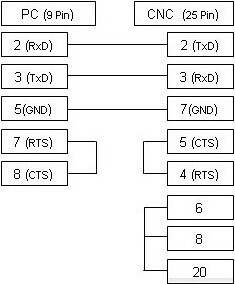
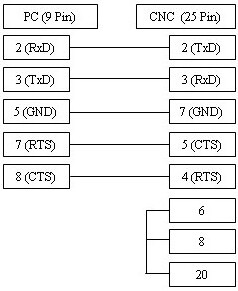
Many CNC controls strictly require specific hardware signals at their ports before they can transmit or receive data. If the signal is missing the machine simply displays an 086 Not ready Alarm as soon as the CNC tries to send or receive data. The solution is a specially soldered cable featuring a so-called loopback bridge which connects the signal pins together internally so the machine supplies its own required clearance signals. See the loopback between pins 6-8-20 at the CNC end of the cable in the cable diagrams below.
Recommended Wiring Diagrams
Solder your cable according to one of the two schemes below. For most standard connections using XON/XOFF (DC1/DC3) software flow control, Scheme 1 is the right choice.
Scheme 1: XON/XOFF Protocol
Special pinout for software flow control. Includes the critical 6-8-20 bridge directly inside the CNC connector.
Scheme 2: RTS/CTS Protocol
Full hardware flow control (hardware handshake) for machines configured for Hardware (RTS/CTS) flow control
Practical Workshop Tips
- Proper Shield Grounding: Use shielded cable. Solder the shield drain wire only on the PC side to the connector shell to prevent dangerous ground loops between the PC and the machine.
- Cable Length Considerations: Keep the RS232 cable as short as possible to minimize electrical interference from motors or variable frequency drives in the workshop.