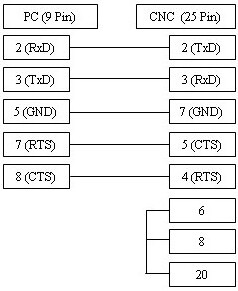
The Bosch CC220 and CC230 controllers are robust industrial systems requiring precise serial interface configuration for stable DNC operation. To ensure error-free data transmission between your PC and the CNC machine, verify that the control parameters align perfectly with your EasyDNC settings. Common communication failures often stem from baud rate mismatches or incorrect handshake implementation. Ensure that the flow control—whether opting for software (XON/XOFF) or hardware (RTS/CTS)—is identical on both devices. Always check for parity and stop bit consistency, as minor discrepancies here frequently trigger framing errors or buffer overflows. Using shielded cabling to mitigate EMI is critical in industrial shop floor environments to maintain signal integrity during high-speed data transfers.
| Parameter | Value | Comments |
|---|---|---|
| Device | Port | (V240,1) |
| DCR | 9600 | Baud Rate |
| Status | SW Control | |
| DFS | Recognise Leader with Trailer | |
| TimeOut | 10 Sec | |
| In EasyDNC set 'Mode=Auto'. Baud Rate as above. | ||
Cable Wiring and Notes
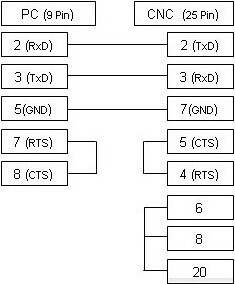
The cable illustrated above is the most commonly used configuration and supports XON/XOFF (DC1/DC3) flow control. If your CNC machine is configured for RTS/CTS (hardware) flow control, please refer to the alternative wiring diagram below, which is designed to support both methods of flow control in most applications.