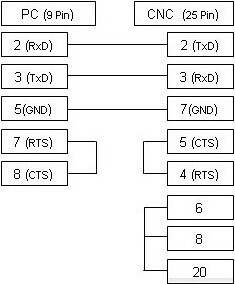
Establishing DNC communication for Okuma 5000 and 7000 controls requires precise RS232 serial interface configuration. Accurate parameterization—specifically regarding baud rate, parity, and flow control—is essential for reliable data transmission. Common pitfalls during setup often stem from baud rate mismatches or conflicts between software (XON/XOFF) and hardware (RTS/CTS) handshaking. Furthermore, improper stop-bit settings frequently lead to frame errors or incomplete file transfers. Our guidelines are engineered to help you integrate your Okuma machine seamlessly into your modern production environment. By verifying these interface settings, you effectively eliminate intermittent transmission errors, buffer overflows, and checksum failures, ensuring your CNC operations remain productive and error-free.
| Parameter | Value | Comments |
|---|---|---|
| 1 | 0 | Number of nulls / bytes at start of tape (Leader) |
| 34 | 10 | |
| 39 | 4800 | Baud Rate |
| 44 | 0 | |
| 45 | 0 | |
| 46 | 0 | |
| 54 | 1 | |
| 57 | 90 | |
| - | 0000 1011 | Optional parameter bits No. 1 (ISO code) |
| - | 1010 1010 | Okuma 7000 – Opt. parameter No. 8 |
| - | 1010 0010 | Optional parameter bits No. 12 (Stop bits / Parity) |
| Output (Punch) | Switch to 'Edit mode': press [F3] (PIP), [F2] (Punch), enter file name, then press [Return]. | |
| Input (Read) | Switch to 'Edit mode': press [F3] (PIP), [F1] (Read), press [Return]. | |
Cable Pinout and Notes
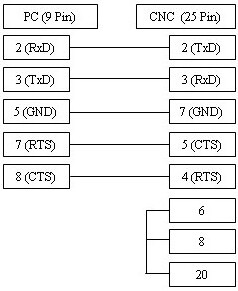
The depicted cable supports Xon/Xoff flow control as well as RTS/CTS, generally ensuring a stable connection. If you do not require hardware flow control, a simple 3-wire cable is sufficient. The diagram for the 3-wire version can be found here.