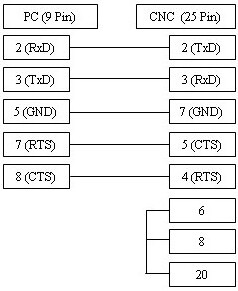
The Mitsubishi M50 control is a robust system widely used in industrial manufacturing. Achieving reliable DNC communication requires precise configuration of the I/O parameters (9000 to 9200 series). When setting up your connection, ensure the baud rate, parity, and flow control (software XON/XOFF or hardware RTS/CTS) match your PC settings exactly. Common issues such as buffer overflows or data corruption are typically caused by mismatched stop bits or conflicting handshake protocols. Verify that your cable pinout aligns with the chosen flow control mode to ensure seamless program transfers and stable DNC operations. Always test the connection with a short program file before attempting large-scale production runs to confirm the integrity of the data stream.
| Parameter | Value | Comments |
|---|---|---|
| I/O Parameters Page 1/6 | ||
| 9001 | 2 | Input Port |
| 9001 | 1 | Input Device |
| 9003 | 2 | Output Port |
| 9004 | 0 | Output Device |
| 9005 | 2 | Tape Mode |
| I/O Parameters Page 2/6 | ||
| 9101 | Out/In | - |
| 9201 | Out/In | - |
| 9102 | 2 | Baud Rate 4800 |
| 9202 | 2 | - |
| 9103 | 1 | 1 Stop Bit |
| 9203 | 1 | - |
| 9104 | 1 | Use Parity = Yes |
| 9204 | 1 | - |
| 9105 | 1 | Parity = Even |
| 9205 | 1 | - |
| 9106 | 2 | 7 Data Bits |
| 9206 | 2 | - |
| 9108 | 3 | Use XON/XOFF (DC1 and DC3) |
| 9208 | 3 | - |
| 9109 | 1 | - |
| 9209 | 1 | - |
The cable illustrated above is the most commonly used version and supports XON/XOFF flow control (DC1/DC3).
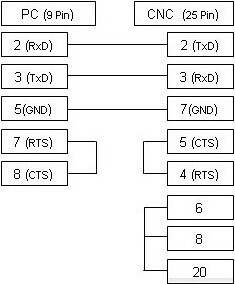
If your CNC machine is configured for RTS/CTS (hardware) flow control, please refer to the alternative connection diagram below, which generally supports both methods of flow control.