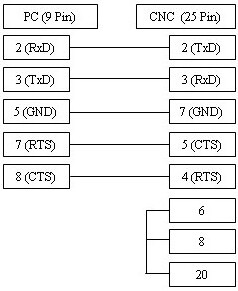
Configuring the serial interface for Hinumerik 2100M and 2100T controls requires precise adjustment of parameters 5010 through 5016. To ensure stable DNC operation and error-free data transmission, baud rate settings and hardware handshaking (RTS/CTS) must be synchronized between the PC and the control. Common communication failures often stem from baud rate mismatches or incorrect flow control settings, which can lead to buffer overflows or framing errors during machining. Utilizing the correct RS232 pinout is critical to maintaining a reliable link. If you experience parity or overrun errors, verify that your data bits, stop bits, and flow control protocol (XON/XOFF vs. RTS/CTS) match the control's specific port requirements exactly. Proper cable shielding and grounding are also recommended to minimize interference in industrial shop floor environments.
| Parameter | Value | Comments |
|---|---|---|
| 5010 | 0 | (00000000) |
| 5012 | 0 | (00000000) |
| 5011 | 11000101 | = 2400 Baud. (11000011=600, 11000100=1200, 11000101=2400, 11000110=4800) |
| 5013 | 11000101 | = 2400 Baud. (11000011=600, 11000100=1200, 11000101=2400, 11000110=4800) |
| 5016 | xx10xxxx | x = Leave unchanged |
| RTS | Line 1 | Select RTS/CTS flow control in your DNC software. |
Cable Pinout and Notes
The illustrated cable supports both XON/XOFF (DC1/DC3) flow control and RTS/CTS (hardware) flow control. If your control does not require hardware flow control, a standard 3-wire cable can be used. A diagram for the simple 3-wire configuration can be found here.
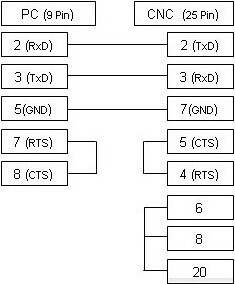
RS232 Cable: 9-Pin (PC) to 25-Pin (CNC)