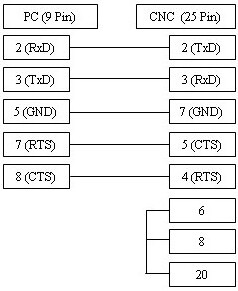
Establishing a robust serial (RS232) connection is critical for seamless data transfer between your Fanuc 16 control and a DNC system. Precise configuration of parameters 0100 through 0103, along with matching baud rates, is essential to prevent parity errors and buffer overflows during NC program transmission. When troubleshooting, verify that your handshake protocol matches: use XON/XOFF for software flow control or ensure your cable wiring accounts for RTS/CTS hardware signals. Always utilize high-quality, shielded cables to minimize electromagnetic interference, which is a common culprit for data corruption in shop floor environments. Proper synchronization of these settings ensures reliable, uninterrupted drip-feed (DNC) performance, maintaining machine uptime and production consistency across all your CNC operations.
| Parameter | Value | Comments |
|---|---|---|
| 0000 | 00000010 | |
| 0020 | 0 | |
| 0100 | 00100000 | |
| 0101 | 10000001 | |
| 0102 | 0 | |
| 0103 | 9 (BaudRate 2400) | |
| 6 = 300 | 7 = 600 | 8 = 1200 | 9 = 2400 | 10 = 4800 | 11 = 9600 | ||
| TV Check | 0 = Disabled | |
| Punch Code | 1 = ISO | |
| Tape Format | 0 | |
| I/O Channel | 0 | |
| Drip Feed: Select Auto/DNC mode on the control. Press Cycle Start. Then go to the computer, prepare the program and click 'Send'. As data begins to flow the machine moves. | ||
| Software: In EasyDNC set Baud Rate, Parity, DataBits and StopBits as above. Set 'Mode=Auto or Fanuc'. | ||
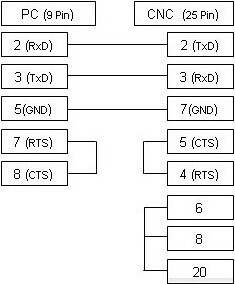
The cable diagram shown above is the most common configuration and supports xOn/xOff (DC1/DC3) software flow control. If your CNC machine is configured for RTS/CTS (hardware) flow control, please refer to the alternative wiring diagram below, which is designed to be compatible with both control methods in most industrial applications.